
Cronos: The New Dawn Review
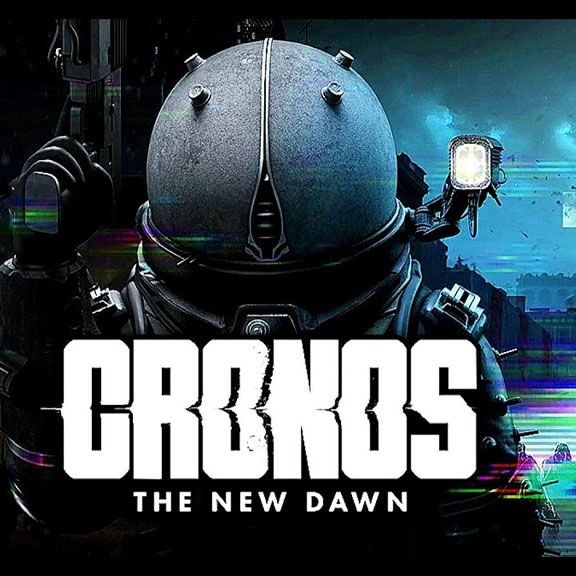
Title: | Cronos: The New Dawn |
Developer: | Bloober Team |
Publisher: | Bloober Team |
Release: | 25.09.2025 |
Ever wonder what would happen if you threw Dead Space, Resident Evil, Silent Hill, and Control into a pot? Then stirred in The Thing by John Carpenter, some post-Soviet aesthetics, and the doomer aesthetic that grew out of them? No? Well, the folks at Poland's Bloober Team decided to find out, and the result was Cronos: The New Dawn. So how did it turn out? Let's get into it.
Over the years, Bloober earned a reputation as a fairly average studio specializing in AA horror. Layers of Fear and Observer both turned out very well, but after that, things didn't quite come together. The Polish studio's games impressed with their visuals and atmosphere, but there was always something missing. That made it especially worrying when Konami announced that Bloober was handling the remake of survival horror's holy grail, Silent Hill 2. Fortunately, the remake was a success and opened the door to the big leagues. Then the Polish team announced its next game, Cronos: The New Dawn, which it had been developing since 2021 alongside the Silent Hill 2 remake. It was the studio's first truly big project and a full-fledged AAA horror game. The funny thing is, horror is the part it didn't get right.
The setup and first few hours of Cronos: The New Dawn really pull you in, mostly because of how much you don't know. You're dropped into a world where nothing makes a damn bit of sense, and you can't help wanting to find out more. A futuristic machine starts the “Lazarus” protocol and wakes up a humanoid in a strange spacesuit called a temporal shell. This is Traveler ND-3576, and judging by the voice and silhouette, there's a woman in that suit. Or something like one. Your mission is simple: find your predecessor, ND-3500. Then they hand you a few more jobs, like placing an anchor and carrying on the work of something called the Collective.
You'll be looking for your predecessor across time, so expect plenty of time travel and time loops. Most of the action takes place in an unspecified future in the ruins of New Dawn. It was once a bona fide city of the future in socialist Poland. In the early 1980s, though, a technological and biological apocalypse struck there and wiped out humanity. You'll travel back several times to December 1981, just before the catastrophe began.
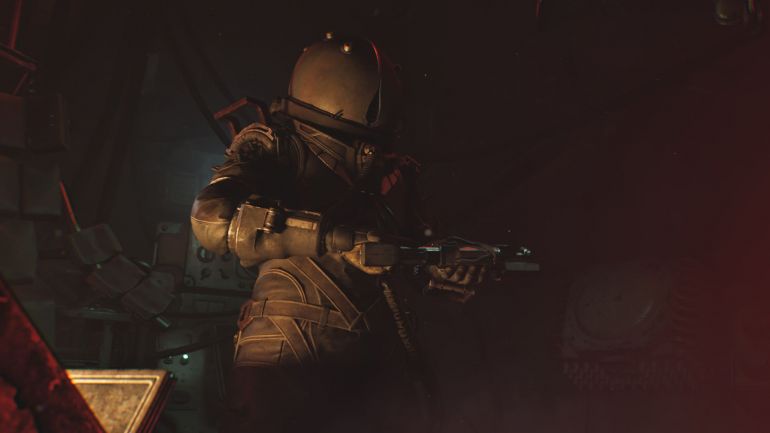
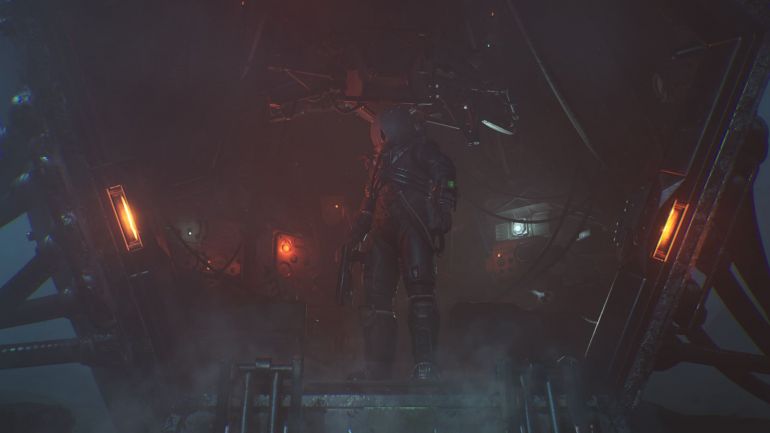
As you untangle the plot, you'll wander through the dead city of New Dawn, inhabited only by hideous creatures known as Orphans. You won't meet living people in the main timeline, though you'll find them in the past and talk to them in cutscenes. The lore also comes through the usual notes , anomalies, and audio diaries left by people and previous Travelers. Even then, nobody explains everything. You'll have to fill in a lot of gaps yourself or look up lore videos on YouTube.
there are an obscene number of them
Being too convoluted without fully telling its story is the first problem with Cronos: The New Dawn. If you like coming up with theories and guesses, that might be a big plus. The next problem with the storytelling is that it doesn't work as horror. There's very little actual horror, and what you do get is hardly inventive. Yes, the game has a lingering, oppressive post-apocalyptic dread, and you can feel how completely f*cked the world is. The jumps back to periods when things are just starting to go to hell help with that. The monsters are creepy and unpleasant, too.
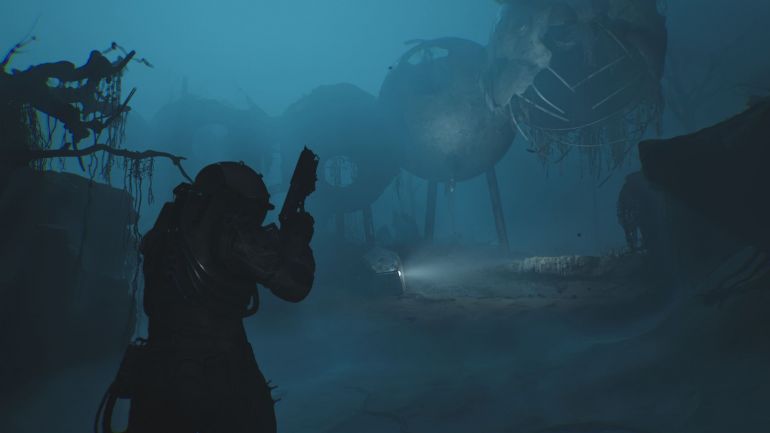
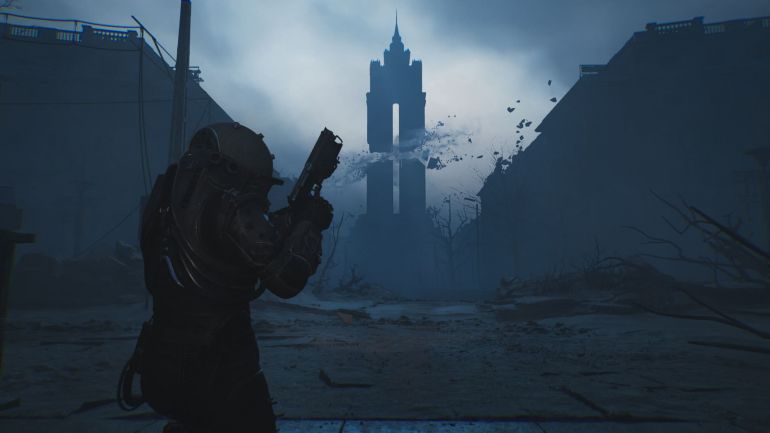
Another problem with Cronos: The New Dawn is that most of the time it feels like an action game dressed up as horror. Resident Evil IV gives you a similar feeling. The heroine, sealed into a strange suit and armed with futuristic weapons, looks and acts like a robot. She shows no emotion whatsoever, fear included. Just think of how rattled Isaac Clarke got from time to time when facing the horrors of the Ishimura. It's hard to care what happens to ND-3576. It might have been funny if her serial number changed after every death, as a hint that she's expendable. The occasional jump scares don't help, either. They're so cheap and repetitive that after the first one they're more irritating than scary.
and V and VI, too
The gameplay is one long string of borrowed ideas. The foundation is mid-2000s survival horror, of course. You'll spend most of your time methodically exploring as you go from point A to point B. Every location is essentially a series of narrow, twisting corridors, a few slightly open areas, and arenas, shuffled and rearranged over and over.
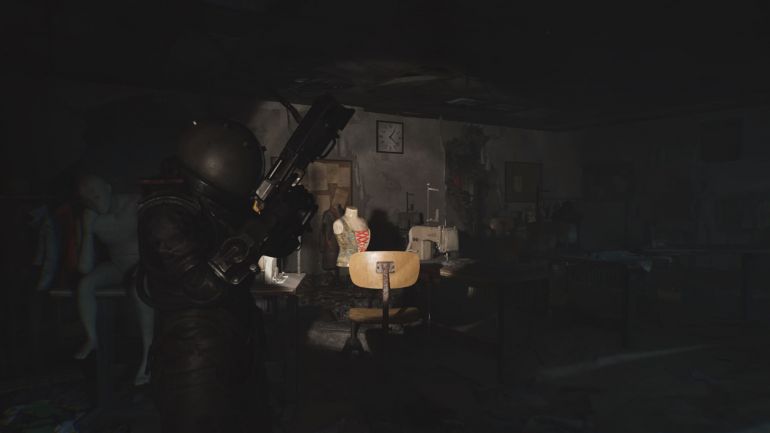
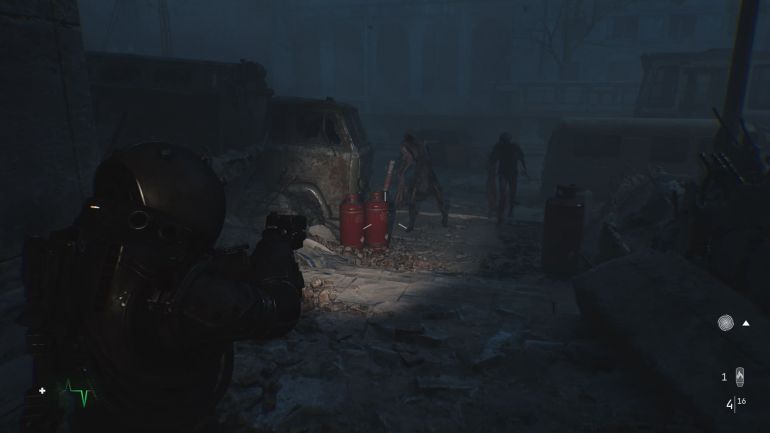
This is an action survival horror game, so you really do have to vacuum up everything in sight. There's ammo, materials for basic crafting, loot to sell, cats , and the local currency: Soviet Planeta 3R12 batteries. Seriously, it's the energy inside the batteries that's the main currency. You'll also need to collect rechargeable batteries and certain kinds of household electronics.
they give you rewards for rescuing them
And if you can collect resources, you can spend them. You do that in special safe rooms , usually set up by previous Travelers. There's a dedicated terminal for saving and a bottomless storage box. Believe me, you'll use it a lot. You can spend Energy on weapon upgrades or extra ammo. Upgrading your suit takes special Cores that you have to hunt down. There's also a dispenser for flamethrower fuel, but we'll get to that in a bit.
another nod to Resident Evil
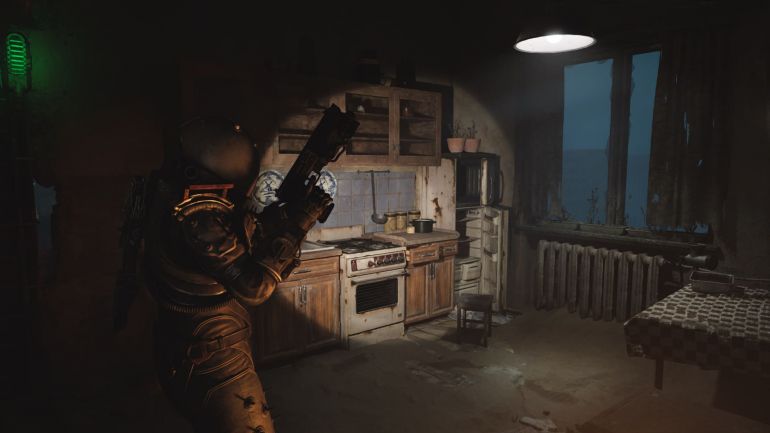
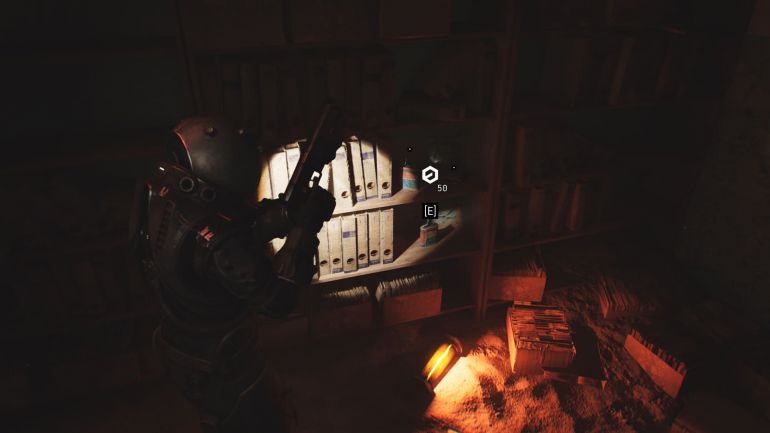
Exploring involves solving puzzles, though you'd expect more than one proper puzzle in a Bloober game. Most of the time you're just looking for keys or door codes. You'll mix reagents once in the whole game. There are some spatial puzzles where you interact with time anomalies to open the way forward . Singularity did something similar in 2010 and did it much better. Toward the end, you also power mechanisms by shooting electrical darts at panels, but that's elementary too. There's a fair amount of backtracking, some of it mandatory and some of it optional, and the game is worse for it.
or reach a secret
The most questionable part of exploration is easily the gravity boots. It's a lot like Dead Space, where you couldn't move freely in zero gravity and had to jump between fixed points. Why bring back a mechanic in 2025 that people criticized back in 2008? Now that's a mystery. It feels out of place in Cronos: The New Dawn, and worst of all, the developers lean on it hard toward the end, deliberately and clumsily padding the game.
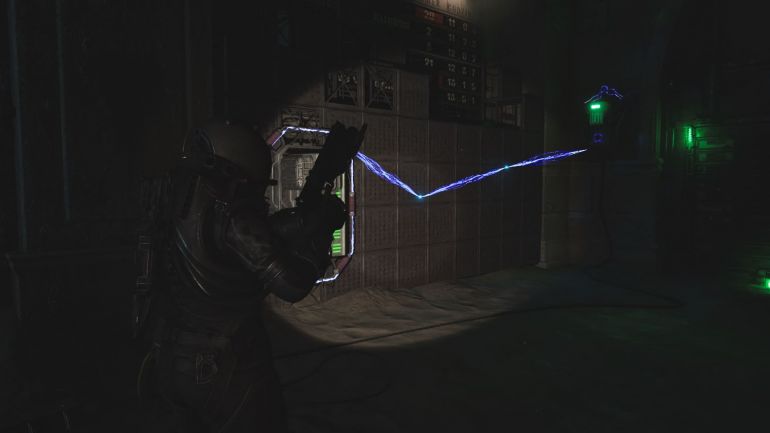
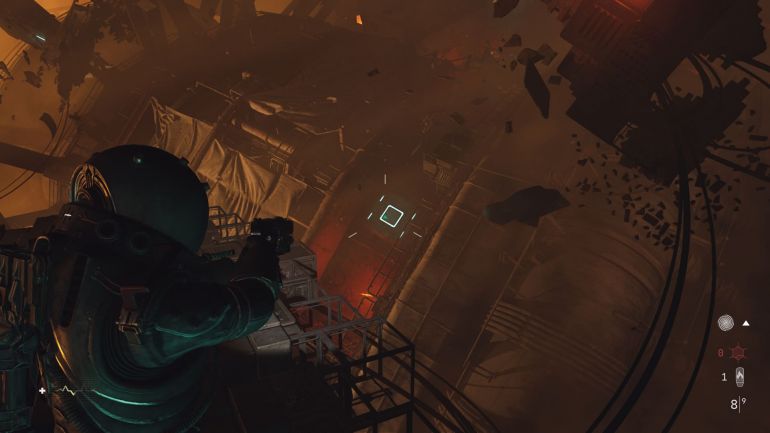
Now for the most active part of the game: fighting enemies. Unfortunately, the combat in Cronos: The New Dawn is hard to call impressive. It's downright stiff. The melee is lifted straight from Dead Space, with punches and stomps. The difference is that in Cronos you'll barely kill anything up close, since the damage is pitiful.
Shooting is a little better, but even a pistol feels like a cumbersome tank gun in the Traveler's hands. Movement is slow, and the game encourages drawn-out fights because most weapons let you charge a shot for extra damage. You can't dodge, so you're better off keeping enemies away. About the only way to change things up is to shoot monsters in the legs, which drops them and makes them easy prey. Don't expect flashy finishers like the ones in The Callisto Protocol. There's no dismemberment, either.
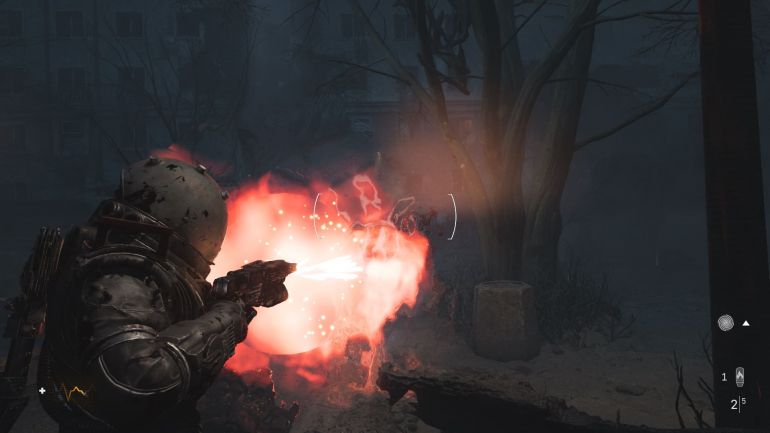
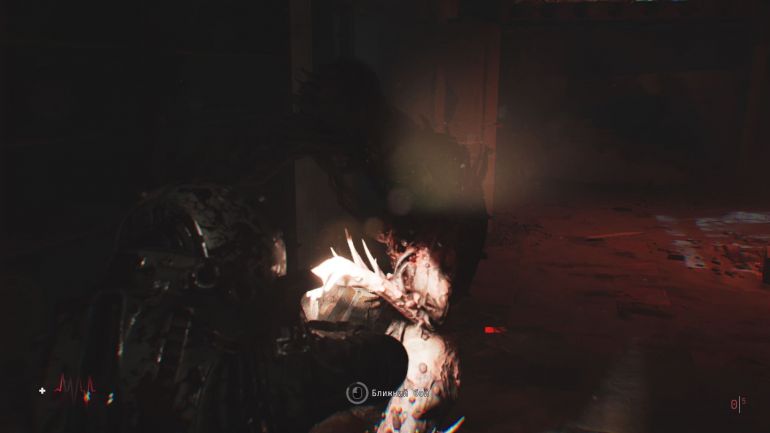
A typical fight in Cronos: The New Dawn goes like this: aim and shoot, run away, repeat until everything in the arena is dead. It's boring, especially near the end, when there are more enemies and they're tougher, so fights drag on. The one thing that helps is that the arenas are usually stocked with explosive barrels.
There aren't many types of monsters. They're all basically variations on Orphans. There are small enemies, big ones, ones that crawl on walls and ceilings, stationary ones, and bosses, most of which are a slog. They all take more or less the same approach: keep them away, preferably by shooting their legs. That doesn't do much for variety. Occasionally you'll come across enemies with partial shells, which can throw a wrench into that approach. You can only kill them by shooting the exposed parts.
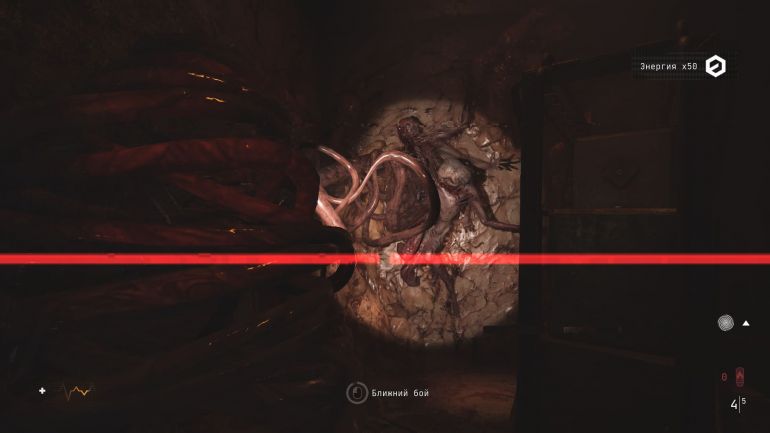
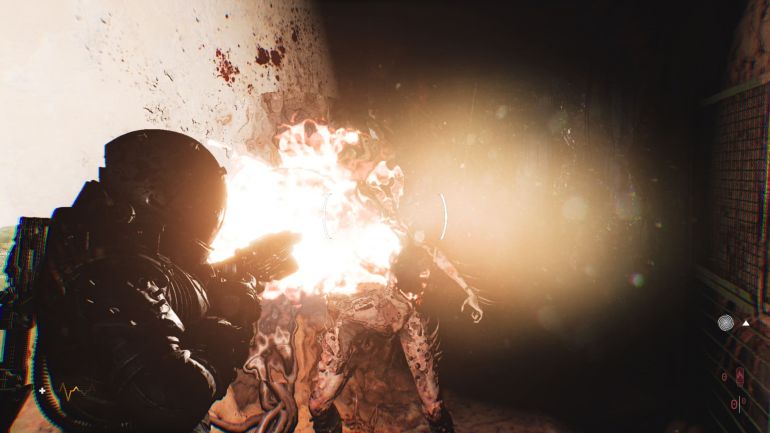
The Orphans' signature trick is that they can absorb the bodies strewn around the levels to get stronger. They can do it repeatedly until they run out of corpses nearby. That includes bodies already lying around and monsters you've just killed. You can't always stop it, since they like to merge somewhere off to the side or right behind you while you're busy with other enemies.
One tactic is to clear bodies with the flamethrower. The trouble is you can never stock enough fuel, even though safe rooms give it out for free, one charge at a time. Stashing it in the bottomless box doesn't work either. You can't fool the system. So you end up running back and forth like an idiot to get fuel and clear a room where you think a fight will happen. Then you realize it's too much of a pain and give up, figuring you'd rather suffer through the fight.
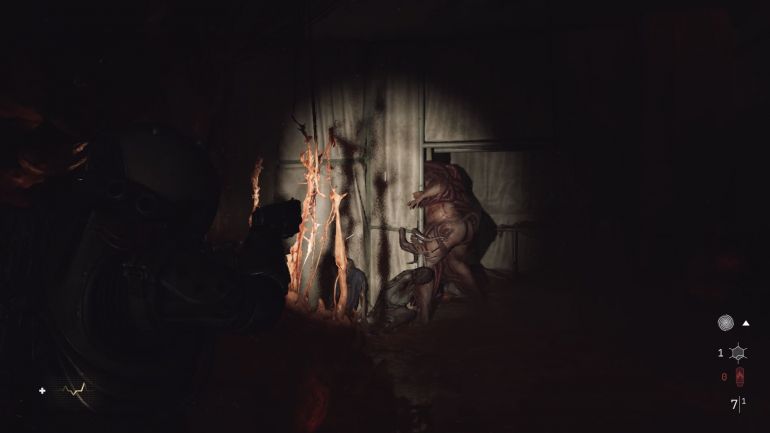
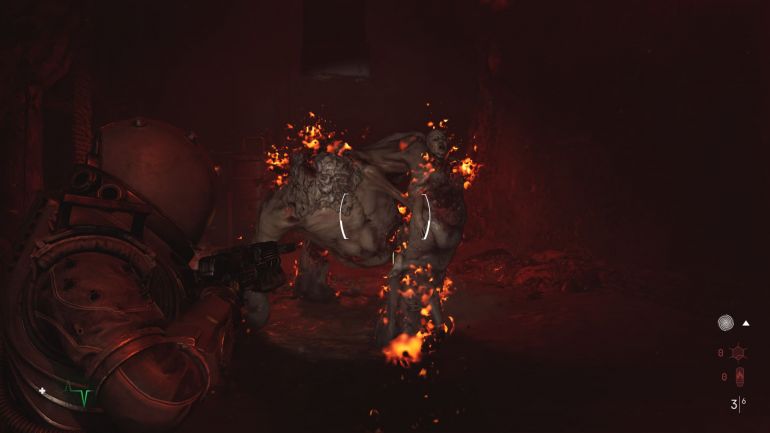
There aren't many weapons, just seven main ones. Two pistols, two shotguns, two carbines, and a powerful launcher that annihilates everything alive within range. It might seem like an odd lineup, but there is some logic to it. The pistols feel different because of their firing modes. One charges shots, and the other fires in bursts. The other weapon types follow a similar pattern. There's also the flamethrower and some explosives.
There's a catch, though: upgrades. Once you start upgrading a weapon, you can't get that Energy back. No matter how hard you try, you won't collect enough to upgrade everything. So on your first playthrough, you'll upgrade what you found first. Naturally, you won't use the weapons you haven't upgraded, which defeats the point of having two pistols, shotguns, and carbines.
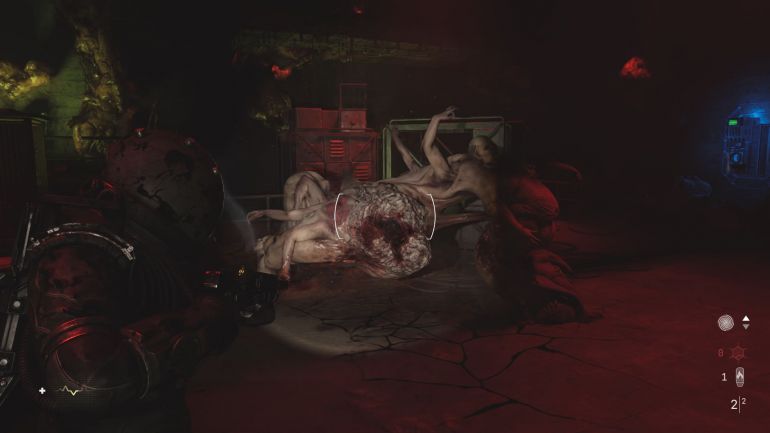
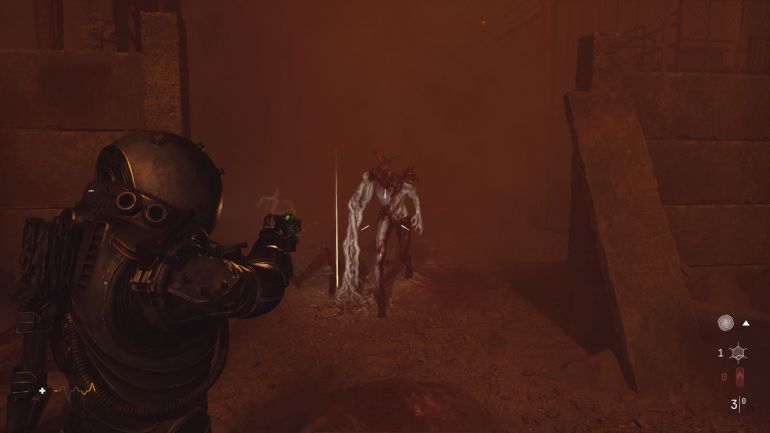
The limited inventory doesn't encourage you to use the whole arsenal either. It's where the game has its biggest problems. Even fully upgraded, you only have 12 slots. For most of the game, three go to weapons and at least three to ammo. You also need at least one healing item, one torch, and one explosive. That leaves three slots to somehow fit story items, upgrade Cores, valuables to sell, or even bolt cutters for locked doors. Funny enough, that one proper puzzle requires four story items. You'll constantly have to go back to safe rooms to unload extra items. What does that achieve? It pads out a game that's already too long.
Phylacteries have much the same problem. They're tied closely to the story, since ND-3576 needs to “extract ” certain characters with a special glove. Once extracted, the subject's essence goes into a phylactery, a special compartment or container in the temporal shell. You can carry up to three personalities at once, each granting certain bonuses. What if every slot is full and you find someone else to extract? You can leave things as they are or erase somebody, destroying their essence for good. Funny enough, you can even do this to characters who are vital to the story, which breaks its logic.
pull out
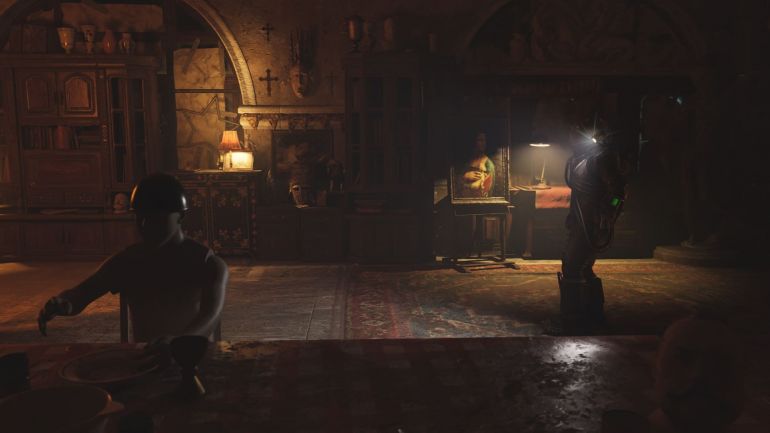
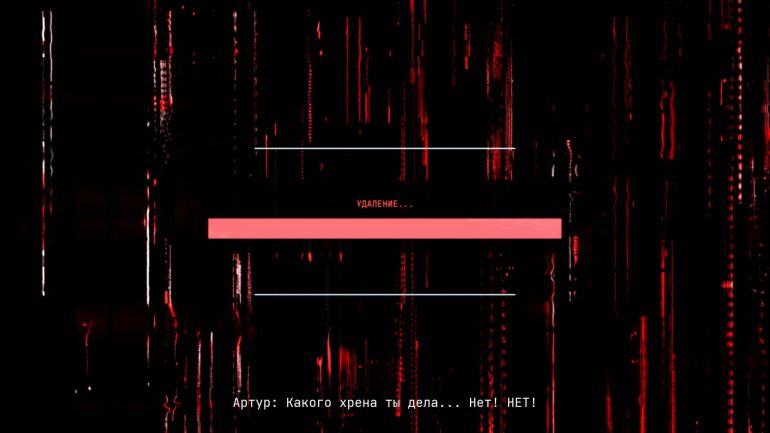
One of the biggest problems with Cronos: The New Dawn is how much it's artificially padded. You start feeling it around the halfway point. It affects everything from the story to the repetitive, often unnecessary fights. Hell, you can get thrown into another scrap in an area you've already cleared. And the nonsense with the gravity boots near the end becomes an unbearable slog.
It's hard to fault the visuals in Cronos: The New Dawn. Its retro-futuristic world is full of Eastern European architecture and some deliciously revolting body horror. Apartment blocks that look like familiar Khrushchev-era buildings are smothered in decomposing bodies fused into walls and corridors of flesh. It gives the game an atmosphere of its own as you explore part of a ruined city rotting before your eyes. It'll make you shudder with disgust. As usual, Bloober did a fantastic job with the visuals and environments.
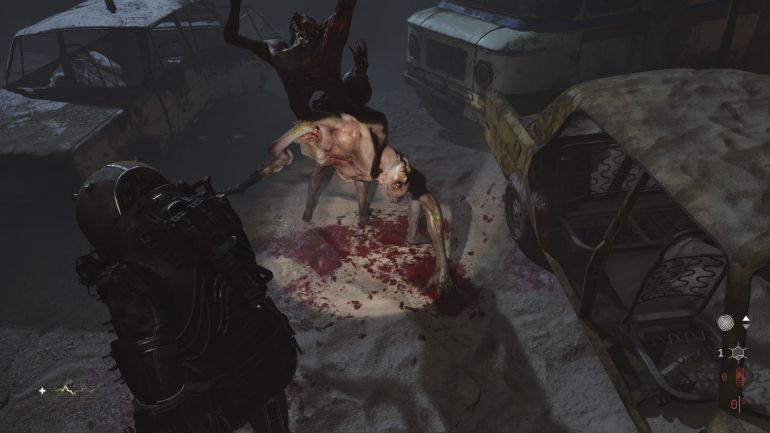
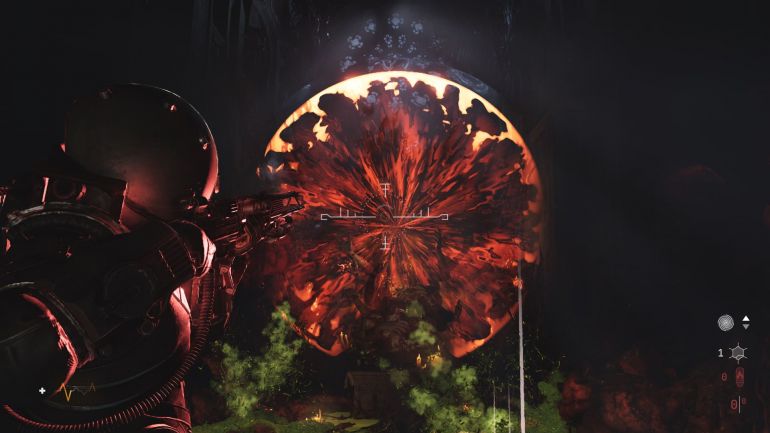
The anxious mood the visuals build so carefully is matched by excellent sound and music. The knocking, groaning, and gurgling biomass are enough to give you chills, though the guns don't sound all that impressive. The background music is mostly sci-fi synth, blending retrowave and dark ambient beautifully. It gets a little too spacey in spots, but it still fits. This is science fiction, after all.
Performance at launch left a lot to be desired, which isn't surprising given the game's size and the detail in its environments. Still, the graphics are hardly cutting-edge. Turn on ray tracing or raise the resolution and the frame rate takes a serious hit, with some stuttering. Even frame generation and upscaling set to Performance don't help much. Overall, it's tolerable.
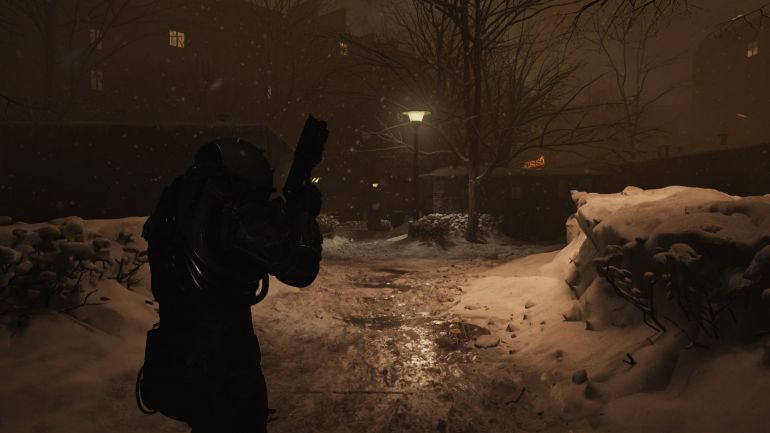
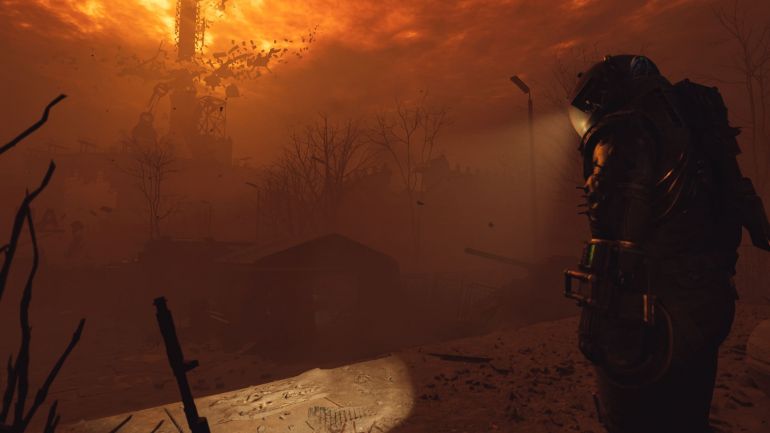
Cronos: The New Dawn is a Bloober game through and through. It's cool, beautiful, and interesting, but something's missing. You won't find gripping gameplay here, a coherent plot, or much horror. Beautiful? Yes. Atmospheric? Absolutely. It's also padded and a slog. Cut a third of the pointless runtime from Cronos: The New Dawn and put what's left into eight packed hours, and you'd have a much better game. As it stands, it's worth finishing once, but you probably won't go back for a second run.
Enjoyed this article? Found it helpful? Support GameSpirit.org and help us create more great content.
Author: Godlike_Goblin for GameSpirit.org


