
The History of DOS as a Gaming Platform.
Computer games have come a long way over their lifetime, from their first steps with tic-tac-toe on the enormous Bertie the Brain mainframe to big-budget productions with an endless number of As attached. Computers gradually escaped the confines of institutes, universities, and laboratories, shrinking dramatically along the way. The early games industry began taking shape in the ’70s. That decade also brought the broad division of gaming hardware into arcade machines, consoles, and home computers.
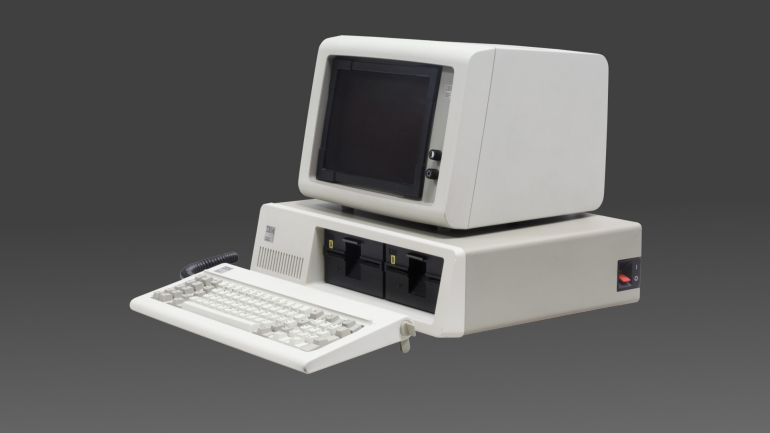
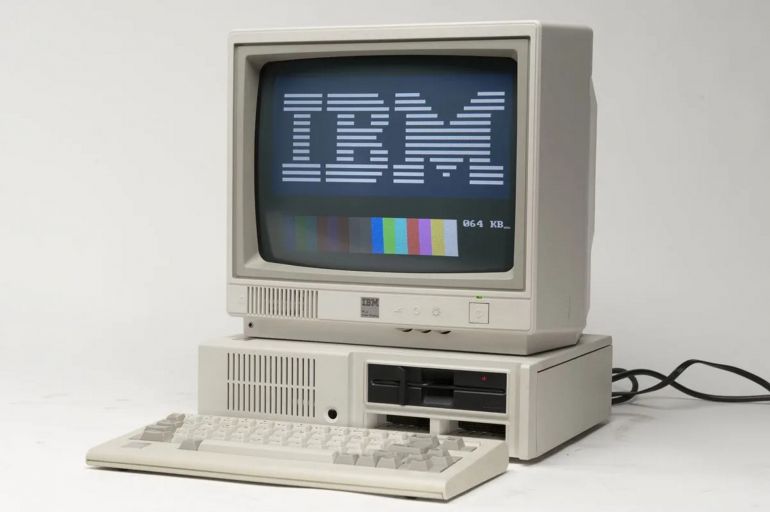
Modern PC gaming, though, traces its roots to the ’80s. More precisely, its starting point was the IBM PC 5150’s release in August 1981. The company’s attempt to break into microcomputers proved enormously successful. Sales of the first PCs exceeded expectations by 800%! Its open architecture, use of off-the-shelf components from third-party manufacturers , and range of configurations* all helped.
Intel’s 8088 processors, for example
The IBM PC was also extremely easy to upgrade. Developing peripherals and software posed few difficulties . More than seven hundred programs appeared for the 5150 in its first year. Its closest rival, Apple, had fewer than two hundred.
compared with rival systems
*You could buy an IBM PC 5150 with either a monochrome or color graphics adapter, with different monitors to match. You could even use a regular TV with a composite input as a display. Models also offered different amounts of RAM: 16 or 64 KB, expandable all the way to 640 KB.
The IBM PC ran PC DOS, or IBM PC DOS . As with the 5150’s hardware, its operating system was outsourced. Initially, on the advice of Bill Gates at Microsoft, IBM approached Digital Research, the leading operating system supplier of the ’70s computer market. It failed to reach an agreement with Gary Kildall, who founded DR and developed CP/M. Amusingly, the real reasons the deal fell apart remain uncertain even today.
IBM Personal Computer Disk Operating System
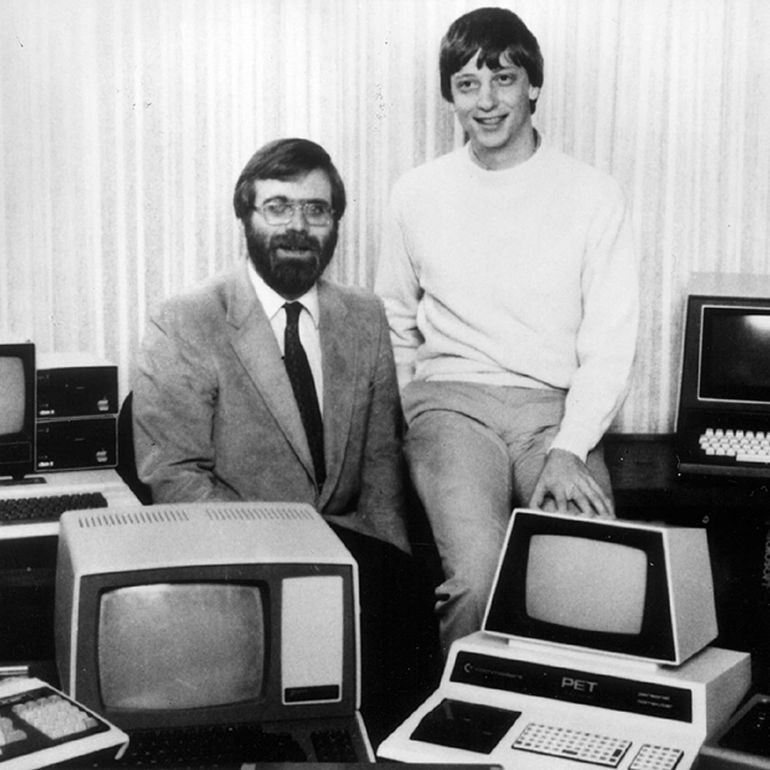
Microsoft then offered to supply the IBM PC’s operating system itself, even though Bill Gates and Paul Allen’s company had no OS of its own. Although young and relatively small, Microsoft had already established a solid reputation supplying its BASIC interpreter, Microsoft BASIC. IBM bought that for its PC 5150 machines too, incidentally.
The plan was fairly simple. Microsoft already had a partner in mind: Seattle Computer Products, where Tim Paterson had developed his own OS, QDOS , for 16-bit 8086 chips. Broadly speaking, it could be considered a clone of Digital Research’s CP/M, although that was not entirely accurate, if only because CP/M did not run on 8086 chips. Still, while Paterson did not use Digital Research founder Gary Kildall’s source code, he did rely on publicly available CP/M documentation. That explains why QDOS shared many API calls and functions with CP/M. In August 1980, QDOS became 86-DOS and went on sale for $95 to buyers of SCP computers, or $195 to everyone else.
Quick and Dirty Operating System
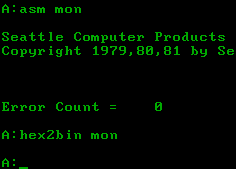
86-DOS suited IBM’s upcoming hardware well. Designed for Intel 8086 processors, it should port easily to the IBM PC’s chosen 8088 chips. Microsoft received its first IBM PC 5150 prototype in November 1980. Bill Gates immediately suggested that IBM license 86-DOS, but, wary of lawsuits after bitter experience, IBM refused. Microsoft therefore had to handle the license itself. In December 1980, it bought one from Seattle Computer Products for $25,000 and agreed to pay royalties on each sale.
At Microsoft, Bob O’Rear was the sole person assigned to adapting the purchased OS for 86-DOS’s needs. In May 1981, however, Tim Paterson, the creator of 86-DOS, joined him. He left Seattle Computer Products and temporarily joined Microsoft to speed up development of IBM’s operating system. That July, Microsoft bought all rights to 86-DOS from SCP for $50,000, while allowing SCP to retain a license to sell its own OS.


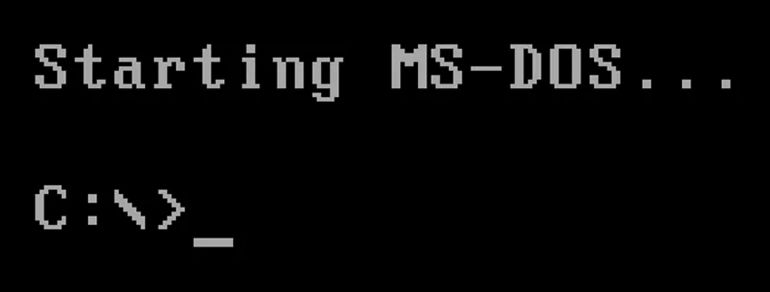
Somewhere around this point, Microsoft’s operating system split into two branches. The first was MS-DOS, the company’s own OS, which it could license and sell independently. Other companies initially gave DOS their own names , but Microsoft later insisted on MS-DOS. The second was PC DOS, whose source code went to IBM for further refinement by its engineers and programmers. Everything was ready by August 1981, and the first IBM personal computers reached stores running PC DOS*.
Z-DOS, DR-DOS, and others
*Interestingly, aware of the similarities between 86-DOS and CP/M, IBM sought insurance against potential lawsuits by approaching Digital Research to license its new CP/M-86 for IBM machines. These machines made up a tiny share compared with the DOS version. Price was one reason: Microsoft’s PC DOS license cost $40, against DR’s $240 for CP/M-86. There was also a third IBM PC variant running UCSD p-System, designed for UCSD Pascal by the University of California, San Diego and SofTech, but those were exceedingly rare.
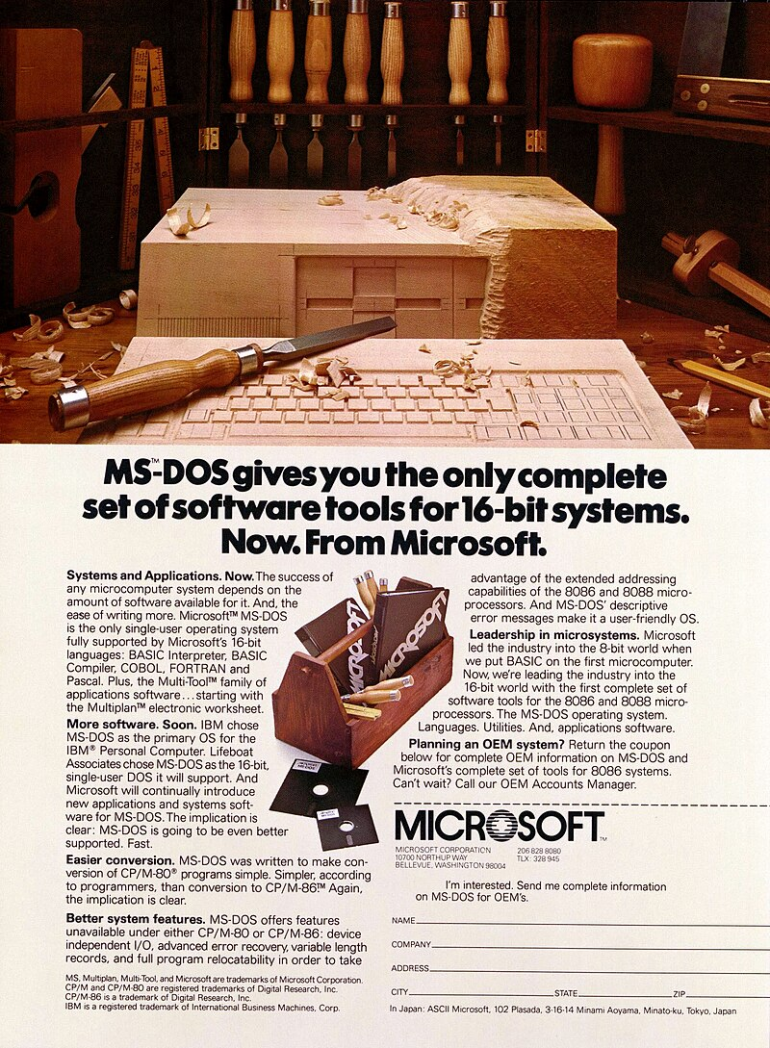
The IBM PC took off, reshaping the computer market in a remarkably short time. Nobody was thinking about games then, since IBM targeted offices more than living rooms. The IBM PC’s success, open architecture, and standard hardware components opened the door to countless third-party software and hardware makers. Following IBM, Sanyo, Compaq, Tandy Corporation, Hewlett-Packard, and others started churning out similar machines. Microsoft began selling them MS-DOS.
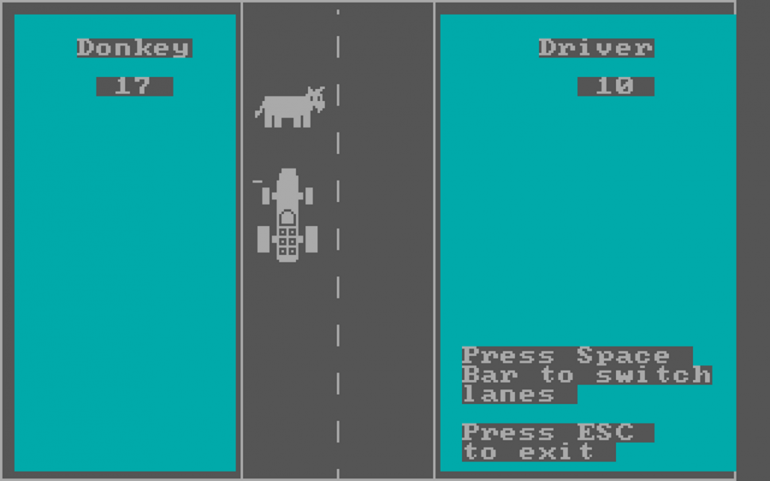
But we are here for games. What happened to those? Well, PC DOS already included one, Donkey. You drove a car down a road, trying not to hit donkeys. Written in BASIC, it was thoroughly lousy. Essentially, it existed for one reason: to demonstrate the IBM PC’s color graphics and sound while advertising Microsoft BASIC, which it was built in. What made it noteworthy was that Bill Gates himself developed it alongside Neil Konzen.
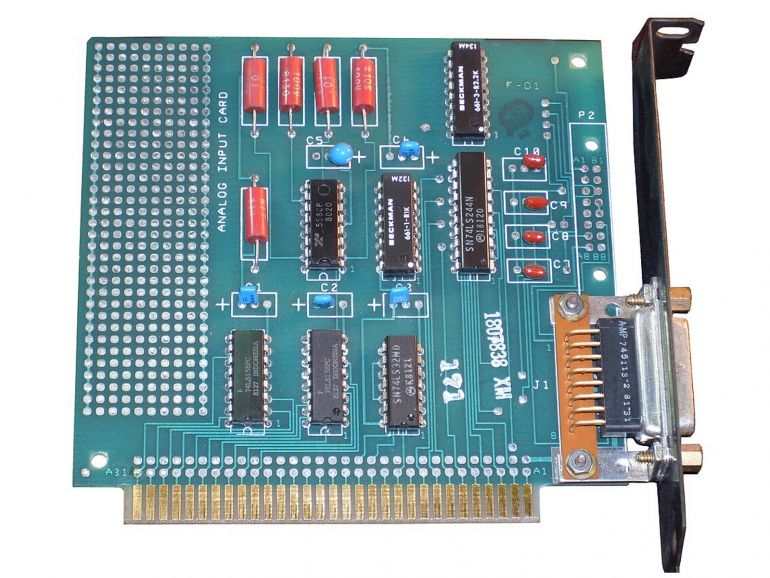
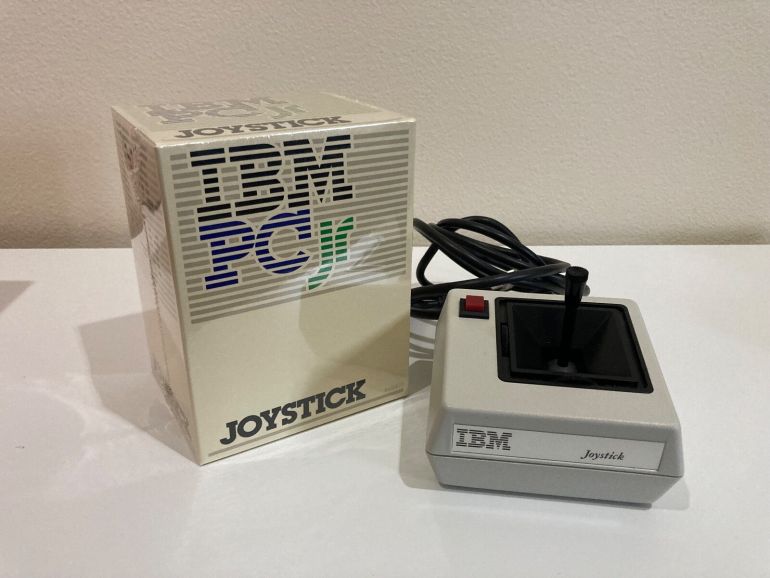
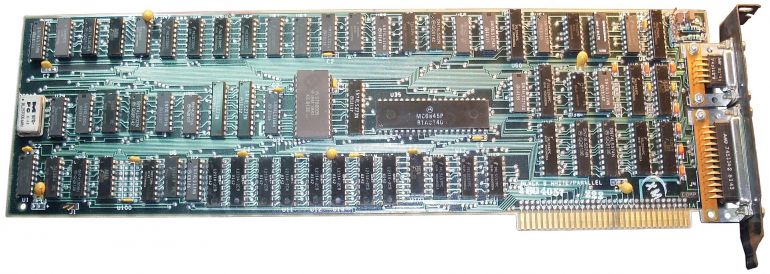
Amusingly, the IBM PC had gaming potential built in from launch, despite being positioned as a workhorse. We are talking about the IBM Game Control Adapter expansion card, which connected two joysticks through a 15-pin D-sub connector. IBM naturally made the controllers too. They resembled Atari 2600 controllers, with a central stick and just one button, although IBM’s also had several adjustment wheels.
Besides a standard text-oriented monochrome adapter, the IBM PC supported both MDA and a CGA card with a 16-color palette and a maximum resolution of 640×200. In practice, though, CGA was often limited to four colors: black, white, pink, and cyan, the signature palette of early DOS games. Displaying the full color range took considerable developer effort, and initially few bothered. In 1982, Hercules released its own IBM PC video adapter, the Hercules Graphics Card , which became fairly popular. Although monochrome, it supported text and graphics modes. The HGC had 64 KB of video memory and resolutions up to 720×348.
Monochrome Display Adapter
Color graphics adapter
HGC
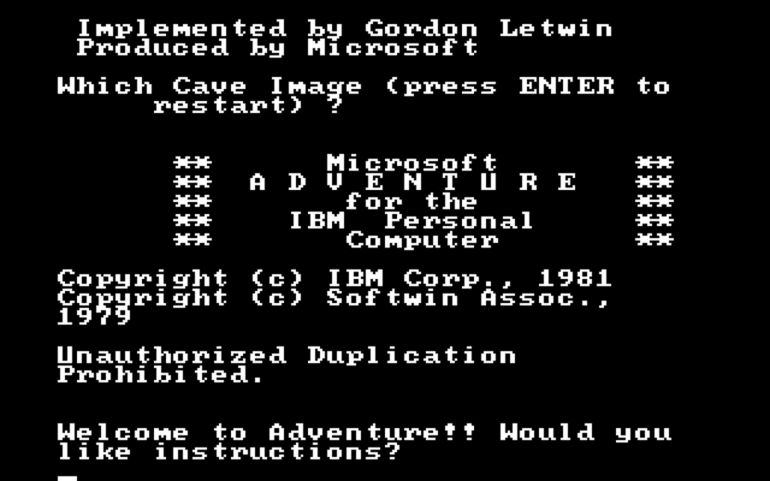
Back to the games. Beyond the playful Donkey demo, the IBM PC received its first serious games in 1981, ported from other computers: Galaxi, The Miser’s House, and Set the Hostages Free. One of the year’s most significant releases was Microsoft Adventure, an interactive text adventure inspired by Colossal Cave Adventure. Microsoft originally developed it in 1979 for TRS-80 and Apple II computers, then quickly ported it to the IBM PC after launch.
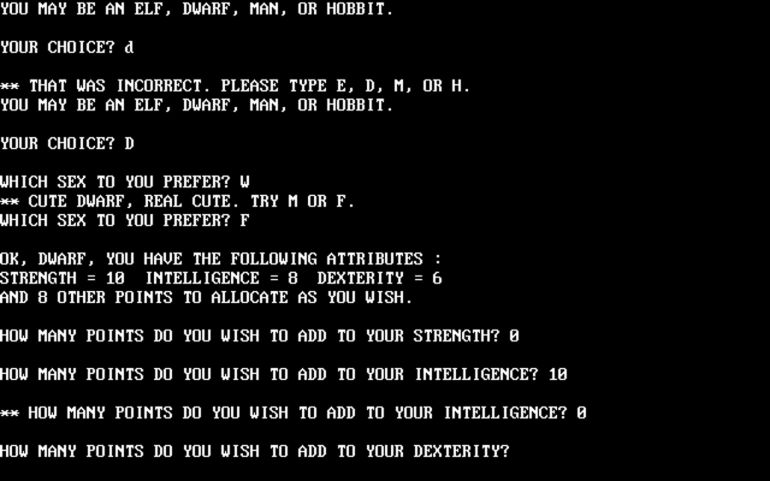
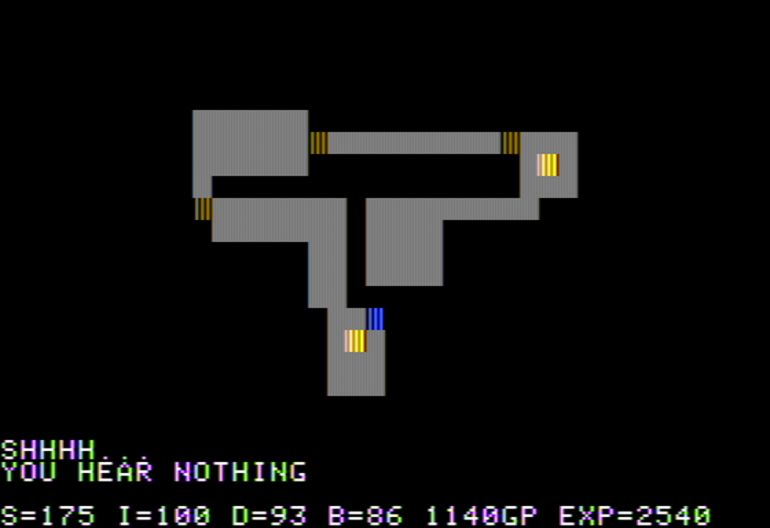
The Wizard’s Castle became one of the first full-fledged RPGs on DOS, even if it was text-based. Like Microsoft Adventure, it was originally made for the popular TRS-80. The game began with character creation, letting players choose their race, attributes, and starting weapon. Gameplay followed the era’s classic text-game formula, using simple written commands for movement and other actions.
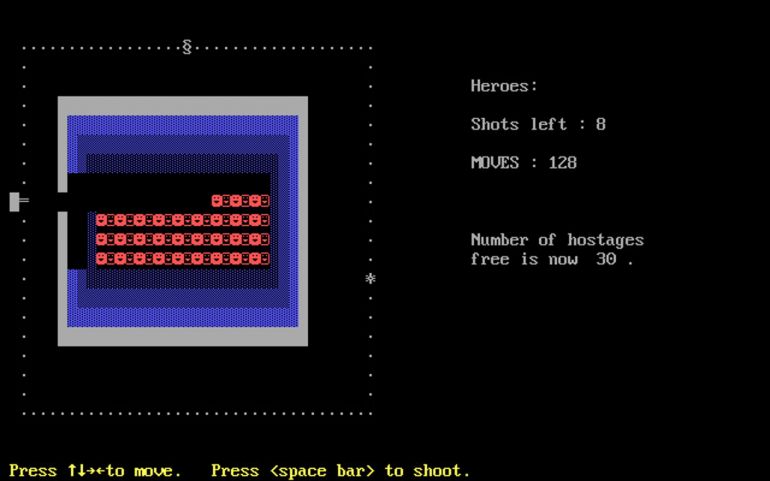
Exclusives unavailable on other computers began appearing almost immediately. Intercept was a science-fiction text adventure about retrieving stolen documents containing a secret rocket-fuel formula. There was the puzzle game The Square, the shooter Set the Hostages Free, and the lunar landing simulator Rocket. All also tried using graphics, however primitive. One of the most visually impressive was the ASCII arcade puzzler Meteor. You controlled a smiley face, clearing solid blocks while avoiding falling meteors.
By 1982, DOS was becoming a fairly popular gaming environment. That year brought 110 games for Microsoft’s OS. For comparison, the Apple II received just over 300. The Commodore 64 and ZX Spectrum, both launched in 1982, each fell slightly short of a hundred. Naturally, the IBM PC’s openness helped, both for hardware upgrades and software development.
The widespread use of IBM PCs with MDA cards encouraged entirely text-based games. These included survival simulator Desert, Everest expedition simulator Everest Explorer, and tactical space combat simulator The Warp Factor. Several Zork text adventures also reached the IBM PC in 1982. Games boasting simulated graphics included the arcade game Pitfall , flight simulator Jetset, arcade game Paratrooper, submarine simulator Seawolf, the odd platformer Apple Panic, and others.
unrelated to Pitfall on Atari 2600
Ports and clones of successful arcade games offered more sophisticated graphics. These included Pac-Man from Greg Kuperberg and Orion Software. Several Space Invaders lookalikes appeared too: Space Strike and Cosmic Crusader. One of the year’s prettiest games was Wizard and the Princess, part of Hi-Res Adventure from On-Line Systems . Microsoft Decathlon and Microsoft Flight Simulator from Microsoft looked impressive too.
Sierra On-Line
By 1983, the IBM PC held just over 25% of the home computer market, behind only the Commodore 64. IBM-compatible machines held another 25%, meaning more than half of all computers already ran DOS. IBM tried to cement that success with a new product, eventually called the IBM PCjr. It was due late that year, but slipped to spring 1984. Interestingly, software, including games, was already being developed for the upcoming PCjr. A major launch title was to be King’s Quest from Sierra On-Line, with IBM itself investing in development.
In 1983, the game count for theIBM PC and DOS rose to 140. Quality improved a little too. Several decent Rogue clones appeared, including The Amulet from Numenor Software. The PC also received the RPG Beneath Apple Manor, whose 1978 original anticipated some ideas from Rogue. Rogue itself, incidentally, reached DOS the following year, 1984. One of the year’s most impressive games was the DOS-exclusive early beat ’em up Bushido from Ebenel Enterprises. The new Ultima, Ultima II: The Revenge of the Enchantress, was also quite good, although it never matched the first game’s popularity.
Then came 1984. The IBM PCjr finally launched in March and flopped, taking King’s Quest down with it. There were several reasons. The hardware was expensive, underpowered, and difficult to upgrade. A Commodore 64 cost half as much. Strangest of all, the new computer was far from fully compatible with the IBM PC. More than half of existing IBM PC software would not run on the PCjr, and some programs even crashed the computer. IBM stopped making the PCjr in 1985.
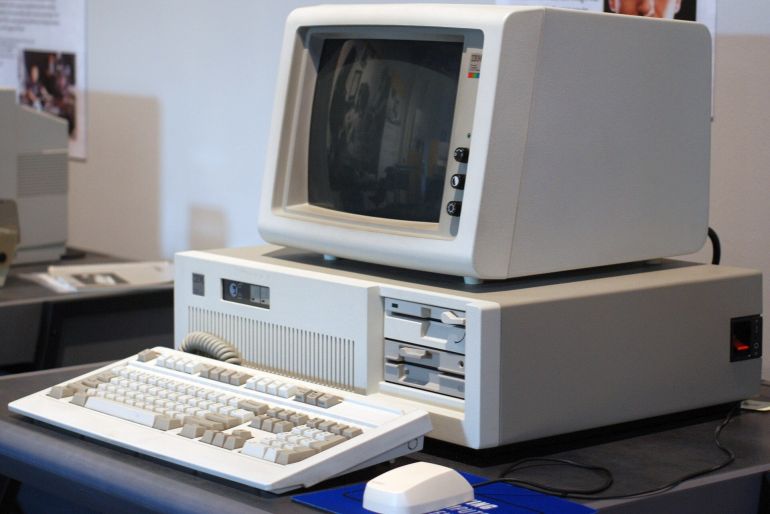
Alongside the PCjr’s failure, IBM also scored another major success: the IBM PC/AT 5170, released in August 1984, an expensive, powerful PC-compatible machine. It used cutting-edge Intel 80286 processors, a 16-bit data bus , and up to 16 MB of RAM. Its video adapter was EGA , but it also supported older MDA and CGA cards. The PGA later joined them for engineering graphics and design. Everything ran on PC DOS. Naturally, this model spawned a whole host of clones from practically every leading computer manufacturer.
ISA
Enhanced Graphics Adapter
Professional Graphics Controller
That year brought even more games. Text adventures remained plentiful: Seastalker, Deadline, Suspect, Enchanter, Starcross, and others. Arcade clones appeared too. David’s Kong, for example, shamelessly copied Donkey Kong. There were direct ports as well, such as Battlezone. One of the earliest RTS and tactical games, The Ancient Art of War, stood out favorably against these. DOS also received an early stealth game, Castle Wolfenstein, previously released on Apple II , 8-bit Atari , and Commodore 64 .
in 1981
in 1982
in 1983
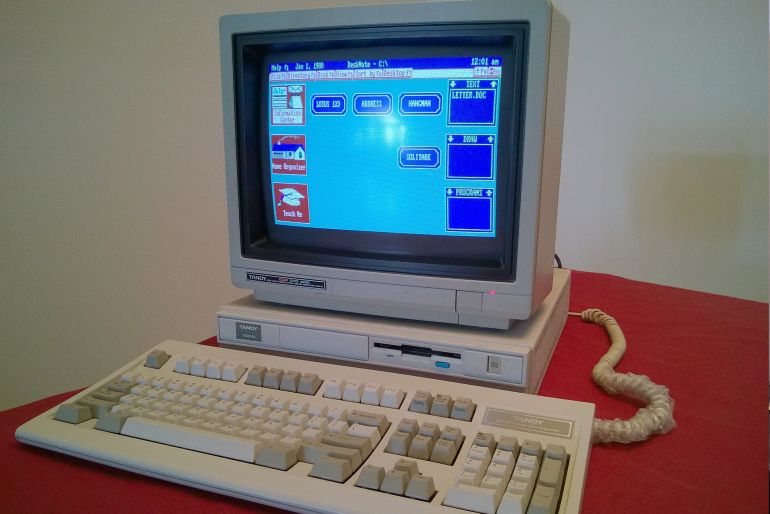
The IBM PCjr’s failure opened the budget market to competitors. In November 1984, Tandy 1000 computers appeared at Radio Shack stores. They were as IBM PC-compatible as possible while supporting PCjr features: an enhanced CGA-compatible graphics controller, a sound generator, and a game port. The new computer cost far less while offering better expansion options, graphics, and sound, including in games. These machines ran their own DOS variant licensed from Microsoft. In this respect, Tandy pushed the market further toward IBM-compatible hardware.
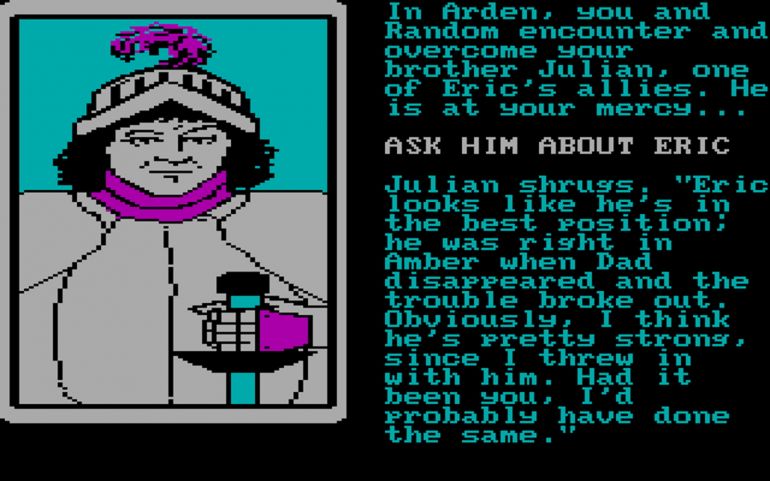
Game numbers dipped slightly in 1985, apparently because of the PCjr’s failure and IBM’s decision to end production. Text adventures still made up a substantial share of the DOS library, but now included games best described as interactive literature. These included Nine Princes in Amber, The Wizard of Oz, Treasure Island, and others. They let players experience the original works’ stories and influence their course to some extent.
The success of more powerful IBM PC and PC/AT clones supporting EGA adapters enabled prettier DOS games that matched the graphics of Apple II and Amiga titles. Not every developer bothered with improved visuals, though. Among 1986’s best-looking games were King’s Quest III: To Heir Is Human, the first Space Quest, and The Black Cauldron from Sierra On-Line. The first Might and Magic also appeared, along with Ghosts ’n Goblins from Capcom, whose graphics were not far behind the arcade version.
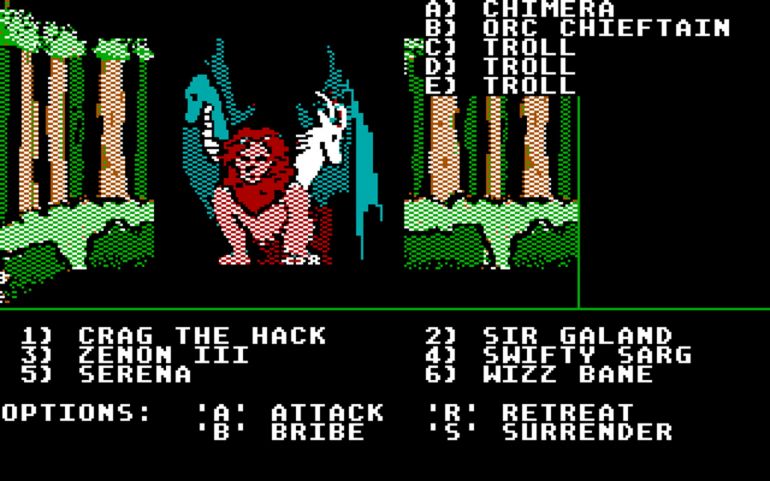
More than 300 DOS games appeared in 1987: Ultima IV: Quest of the Avatar, Beyond Zork, The Ancient Art of War at Sea, Elite, Lode Runner, Wizard’s Crown, and Defender of the Crown. The first The Bard’s Tale arrived. Sierra On-Line released the first Police Quest, while Space Quest and King’s Quest received sequels. The original King’s Quest was reissued for DOS after appearing on the unsuccessful PCjr.
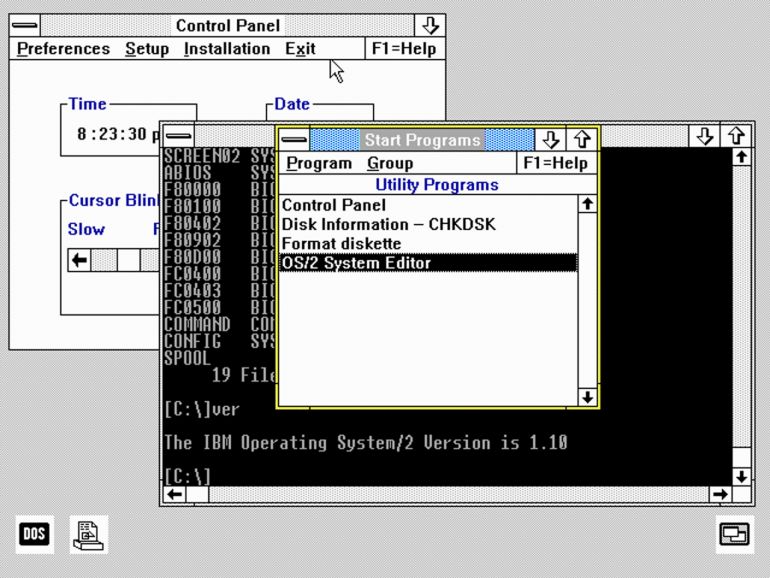
That same year, Microsoft made its first serious attempt to move beyond DOS toward a graphical operating system. Together with IBM, it released OS/2, in development since 1985. At launch, however, it worked only in text mode. Moving to graphics took roughly a year, with the new interface named Presentation Manager.
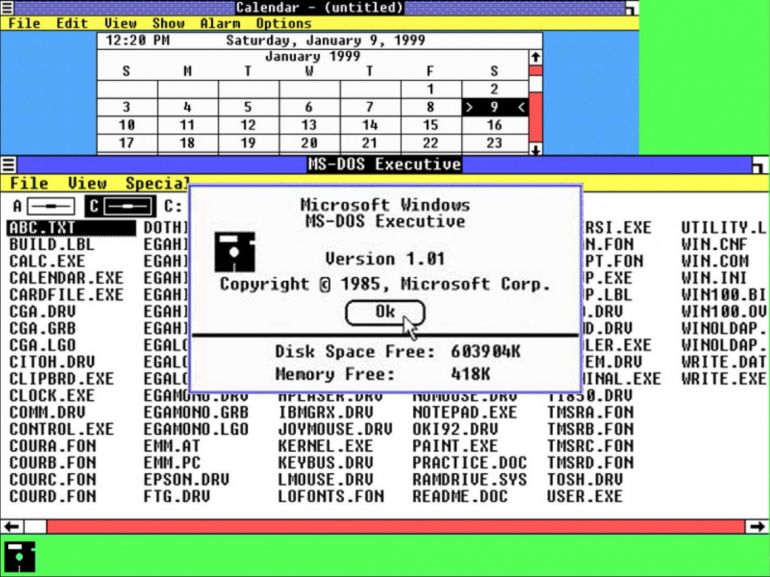
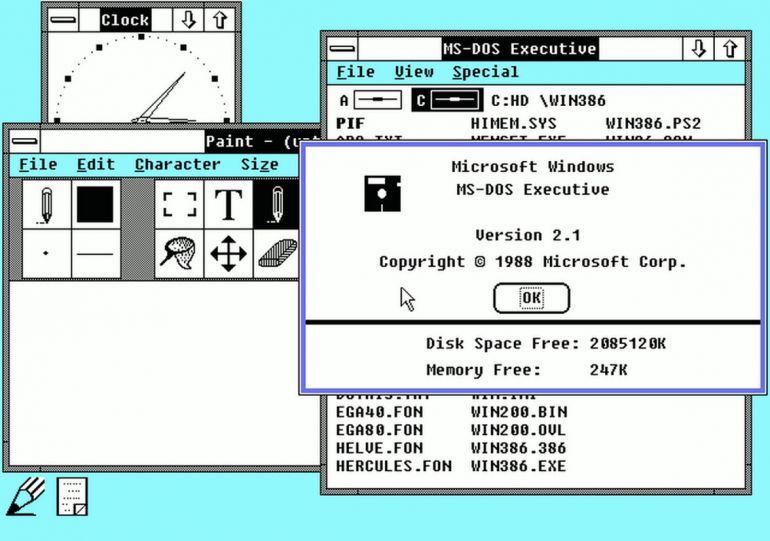
Microsoft had actually started in this direction in 1983, experimenting with graphical shells for MS-DOS. That followed Bill Gates noticing the VisiOn graphical environment for DOS and the IBM PC in 1982. Three years later, Microsoft released the first Windows, Windows 1.0. It supported the basic graphics editor Paint and word processor Write, alongside Notepad, Calendar, Clock, and Control Panel. It also included the simple game Reversi. Unfortunately for Microsoft, Windows 1.0 never became particularly popular.
The second attempt, Windows 2.0, released in December 1987, went far better. Its updated interface let users resize application windows and overlap them. Icons appeared, keyboard shortcuts became available, and programs could be minimized without closing them. The shell arrived with Word and Excel. Windows 2.0’s interface was almost identical to the Presentation Manager graphical shell for OS/2 from Microsoft and IBM.
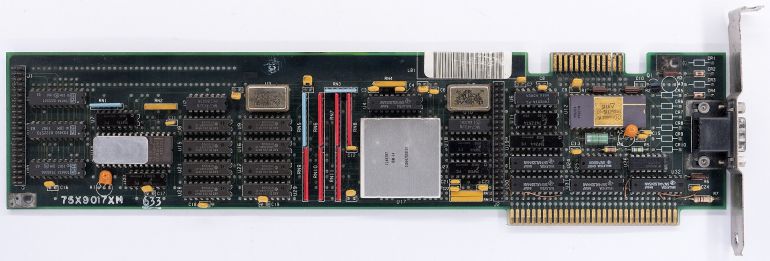
In the second half of the ’80s, a new format replaced EGA and compatible graphics cards from IBM and others. In March 1987, IBM released its Personal System/2 line, based on the Intel 80286. These computers used a VGA controller supporting up to 640×480 in 16 colors or 320×200 in 256 colors. By the early ’90s, VGA became the standard connector for monitors and projectors on PCs and other devices, replacing many older connections. These computers also popularized six-pin PS/2 keyboard and mouse ports. Sound cards for IBM-compatible machines appeared in 1987 too. Together, these developments enabled a considerable leap in the graphics of IBM-compatible computers and DOS systems.
Video Graphics Array
More than 400 games were released in 1988. They included Ultima V, The Bard’s Tale II, BattleTech: The Crescent Hawk’s Inception, Pool of Radiance, Heroes of the Lance, Bionic Commando, and Microsoft Flight Simulator . Arcade ports that year included Double Dragon, Contra, Renegade, and Rampage, although none looked particularly good. The first Lucasfilm adventures, Maniac Mansion and Zak McKracken and the Alien Mindbenders, arrived that year too.
v3.0
In 1989, computers running DOS received more than 600 games. One standout was SimCity. It supported every old IBM PC graphics adapter, including HGC , while its EGA version was among Maxis’s first releases and one of the game’s best-looking versions. Some developers also gradually stopped adapting games for platforms beyond DOS. Die Hard and Ghostbusters II from Dynamix, Don’t Go Alone from Sterling Silver Software, and Star Fleet IIcould only be played on IBM-compatible computers.
Hercules
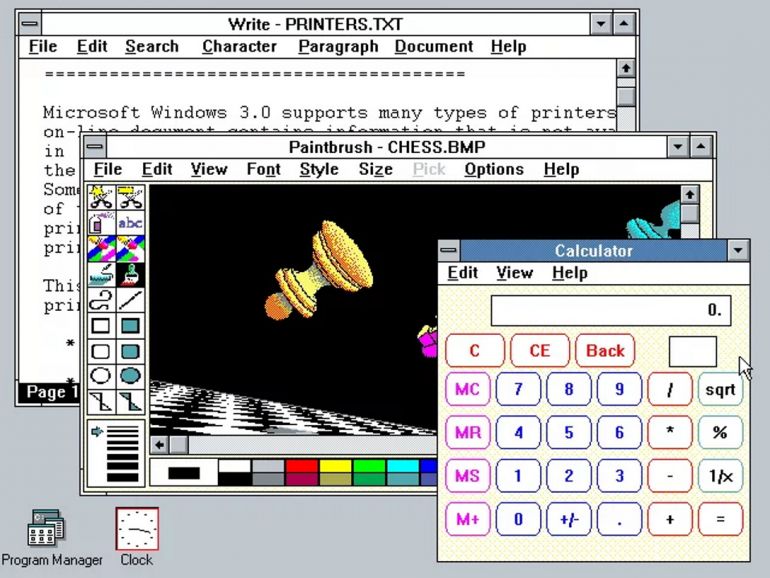
In May 1990, Microsoft released Windows 3.0. Its improved interface resembled OS/2’s Presentation Manager and supported both older EGA and newer VGA adapters. The new shell ran on DOS 3.1 or later, with support for multimedia . Solitaire joined Reversi, which was soon replaced by Minesweeper. Windows 3.0 was enormously successful and made Microsoft a tidy sum. By year’s end, disagreements between Microsoft and IBM ended all agreements between them. IBM retained OS/2, while Microsoft took its OS/2 3.0 work and, under Dave Cutler, turned it into Windows NT by 1993: the first 32-bit Windows, aimed at business users. Home computers had to wait another couple of years for their Windows, until Windows 95 arrived in 1995. We all know by now that Microsoft did a much better job developing its product.
music and video
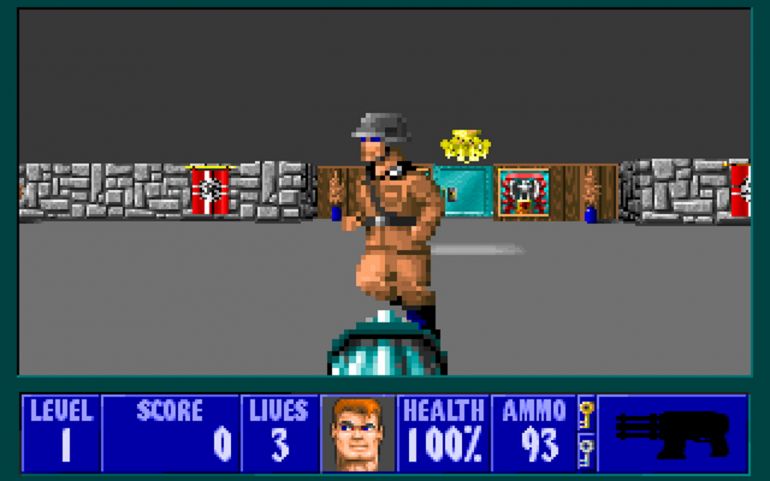
While Microsoft gradually took over the OS market with Windows, its other creation, MS-DOS, reached its gaming peak in 1993 and 1994. Those two years saw the highest DOS release counts, more than 800 games. HeroQuest, Warlords, MechWarrior, Wasteland, King’s Bounty, Populous, The Secret of Monkey Island, Prince of Persia, Commander Keen, Castlevania, Metal Gear, Golden Axe, Sid Meier’s Civilization, Duke Nukem, Wolfenstein 3D, Alone in the Dark, Doom, Command & Conquer, Warcraft,Tomb Raider,The Elder Scrolls, and countless other equally great games appeared on DOS.
In the second half of the decade, DOS game releases gradually declined. Developers maintained the pace in 1995 and 1996, releasing around 700 titles each year, but the figure fell below 200 in 1997. Other home computers were receiving fewer than 50 games each by then, though, and some had lost support entirely, yielding their place to IBM-compatible computers, or simply Personal Computers/PCs.
Commodore 64, Amiga, Atari ST, Zx Spectrum
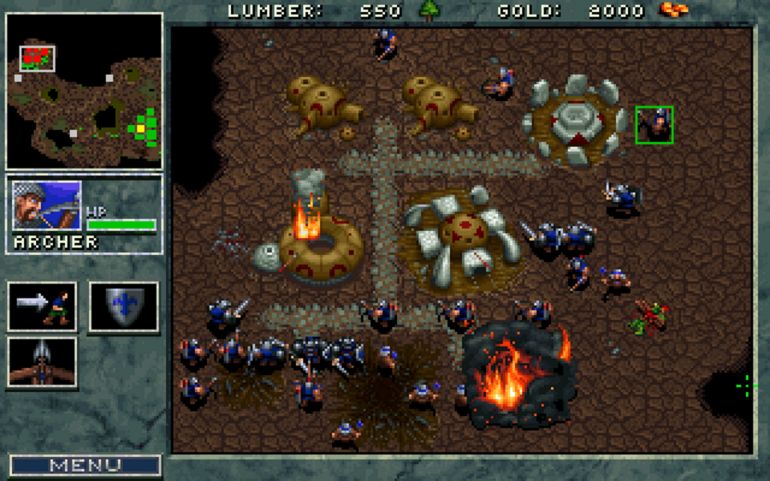
Even during Windows 95’s development, Microsoft understood perfectly well that video games could boost sales of its new OS. In 1994, it began sounding out developers about the likelihood of moving games from MS-DOS to Win95. Their answers were discouraging, primarily because Windows lacked even direct hardware access, and Windows itself ate up a substantial share of system resources.
To make developers’ lives easier, Microsoft released DirectX in September 1995, integrating it into Windows 95 as a library suite: DirectDraw for raster graphics, DirectSound for sound, DirectPlay for multiplayer, and DirectInput for controllers, along with Autoplay, or automatic playback, which let software installation begin immediately after inserting a CD. DirectX provided a standard interface covering the wide range of PC graphics and sound cards available at the time, helping the games industry develop further. Summer 1996 brought Doom 95 for Windows, the first game to support DirectX.
All of this became the final nail in DOS’s coffin. From 1995 onward, Windows releases only increased, while DOS gradually faded from memory. MS-DOS remained part of new Windows versions, however. Win95 integrated MS-DOS 7.0, which could run independently of the Windows graphical interface. Win 98 andME used MS-DOS 8.0, which could no longer boot separately from Windows. This was the final DOS version. It lasted until 2006, when support ended alongside Win 98 and ME.
If all this has made you want to revisit the good old days or discover MS-DOS-era games for the first time, you can still do so today. OldGame.cz has an impressive collection of classic DOS games, many playable right in your browser without fiddling with emulators or settings.
Enjoyed this article? Found it helpful? Support GameSpirit.org and help us create more great content.
Author: Godlike_Goblin for GameSpirit.org


